The “free” option has a price. It just doesn’t come with an invoice.
Every organization that loses a finance lead goes through a version of the same conversation.
The Executive Director looks at the budget. The board asks whether now is really the right time to hire. Someone suggests distributing the work temporarily. The operations manager can cover month-end, the ED can review grants, it’ll be fine for a few months. The job gets posted on LinkedIn. The search begins.
And the gap stays open.
This is the moment we wanted to quantify because the “leave the gap and manage” decision gets made without a real cost comparison almost every time it’s made. The full-time hire option comes with a salary and a recruiting fee. Those numbers are visible and feel large. The vacancy option comes with nothing on the invoice, which makes it feel conservative.
It isn’t.
How we built this comparison
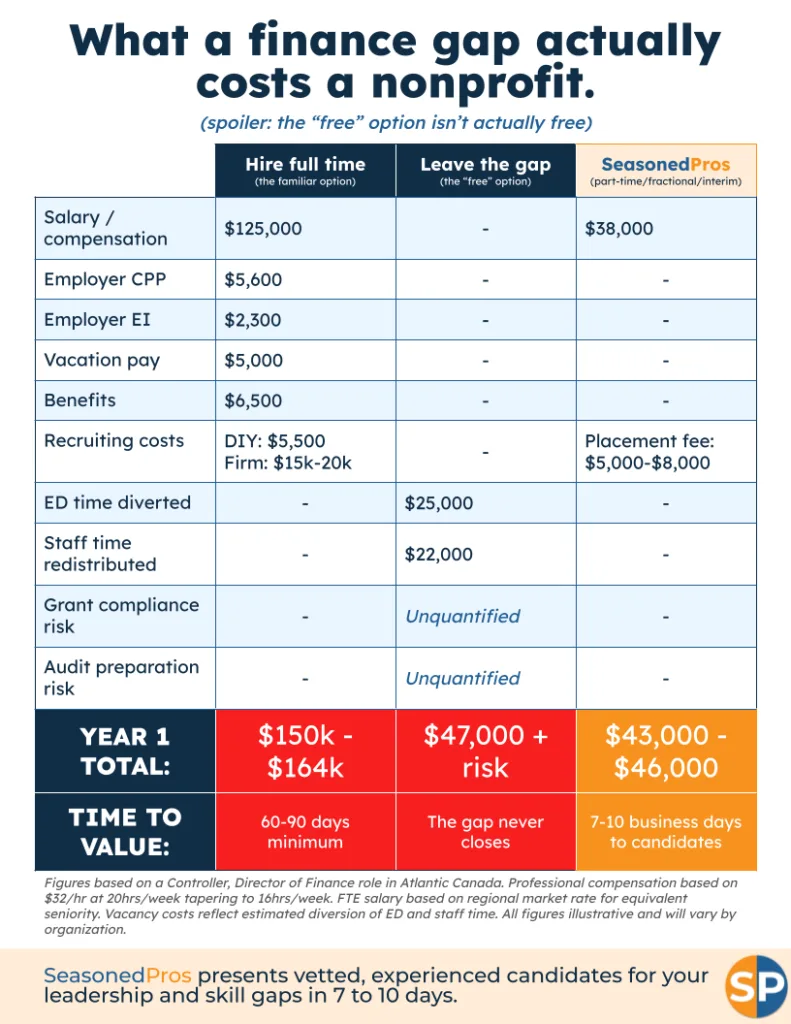
The figures below are based on a Controller or Director of Finance role in Atlantic Canada. We used a professional compensation rate of $32/hour at 20 hours per week, tapering to 16 hours as the engagement matures. FTE salary is based on the regional market rate for equivalent seniority. All figures are illustrative and will vary by organization, but the pattern they reveal is consistent.
We looked at three options.
Option 1: Hire full-time
A full-time finance leader at this seniority level runs $125,000 in salary in the Atlantic Canadian market. Add employer CPP ($5,600), employer EI ($2,300), vacation pay ($5,000), and a typical benefits package ($6,500), and the compensation cost alone lands at $144,400.
Recruiting adds to that. A DIY search, covering LinkedIn posts, internal HR time, and screening, typically costs around $5,500 in staff time and fees. A retained search firm costs $15,000 to $20,000. That brings the Year 1 total to somewhere between $150,000 and $164,000.
Time to value: 60 to 90 days minimum, from posting to start date.
Option 2: Leave the gap
No invoice. No commitment. No hard number to present to the board.
But the work doesn’t disappear. At a 15 to 20 person nonprofit, a finance leader typically accounts for 20+ hours per week of active capacity: month-end close, grant tracking, compliance reporting, audit preparation, payroll oversight, and budget management. When that role goes empty, those hours get redistributed to the ED, to operations staff, to whoever has the least buffer.
‘…the “leave the gap and manage” decision gets made without a real cost comparison almost every time it’s made.’
We estimate the value of ED time diverted at approximately $25,000 annually, based on the opportunity cost of the highest-paid person in the organization spending meaningful hours on work outside their role. Staff time redistributed adds another $22,000, accounting for tasks absorbed by operations, administration, and program staff who were already at capacity.
That’s $47,000 in estimated cost, before accounting for two line items that don’t have clean dollar figures: grant compliance risk and audit preparation risk. Both appear as unquantified in our comparison because they genuinely are. The cost of either materializing is organization-specific and can be severe.
Time to value: the gap never closes. The redistribution continues indefinitely until the search concludes or the situation becomes a crisis.
Option 3: SeasonedPros (part-time/fractional/interim)
A part-time or fractional Controller through SeasonedPros at 16 to 20 hours per week costs approximately $38,000 in professional compensation annually. Add the placement fee ($5,000 to $8,000), and the Year 1 total lands between $43,000 and $46,000.
No employer CPP. No employer EI. No vacation pay. No benefits. No extended recruiting process.
Time to value: vetted candidates presented within 7 to 10 business days.
What this comparison actually shows
The full-time hire is the most expensive option by a significant margin. $150,000 to $164,000 in Year 1 against a SeasonedPros engagement at $43,000 to $46,000. That gap exists because the full-time hire includes a permanent compensation structure built for a 40-hour week, when most nonprofits at this size don’t need and can’t fully utilize a senior finance leader at that capacity.
The vacancy option is more expensive than most organizations realize, and the costs it carries are distributed across people rather than consolidated into a budget line. They’re real. They’re just harder to see.
‘When that role goes empty, those hours get redistributed to the ED, to operations staff, to whoever has the least buffer.’
The SeasonedPros column is the lowest total cost on this table. It’s also the fastest path to a qualified person actually doing the work.
The conversation worth having
This isn’t an argument that the fractional model is right for every organization in every situation. There are cases where a full-time hire is the correct long-term answer, particularly for organizations at a scale where a senior finance leader needs 35+ hours per week and a permanent strategic relationship.
But for a 10 to 30 person nonprofit carrying a finance gap right now, the default conversation usually skips this comparison entirely. The board anchors to whichever number they encountered first. If someone already looked at a job board posting, the SeasonedPros placement fee looks large by comparison. If someone got a quote from a retained search firm, the picture looks different. The point isn’t which option wins in every case. It’s that the comparison rarely gets made explicitly, and the vacancy option almost never gets a real number attached to it, even though the costs are just as real as anything on a salary line.
And while we built this example around a finance role because finance gaps are among the most common and most quantifiable, the same structure applies across leadership functions. Operations. Marketing and communications. IT management. Human resources. The costs of vacancy and redistribution follow the same pattern regardless of the function going unfilled. The dollar figures change. The logic doesn’t.
We built this comparison because we’ve had this conversation with a lot of organizations, and we wanted to give people a way to have it themselves. If it raises questions worth talking through for your organization, we are here to help.

SeasonedPros offers fast access to a network of business professionals ready to tackle complex challenges and drive organizational growth. Resource expertise faster with on demand talent for fractional, interim or project roles. Reach out today to learn how we can help: